 What we keep on the shelfnhum essays
What we keep on the shelf
The objects we hold onto say things about us we have never said out loud.
Best with: A cup you have owned for years. Keep beside you: Attar roll-on.
Look at a bookshelf in any home and you will learn more about the person who lives there than an hour of conversation would tell you. Not from the titles alone. From what sits beside them.
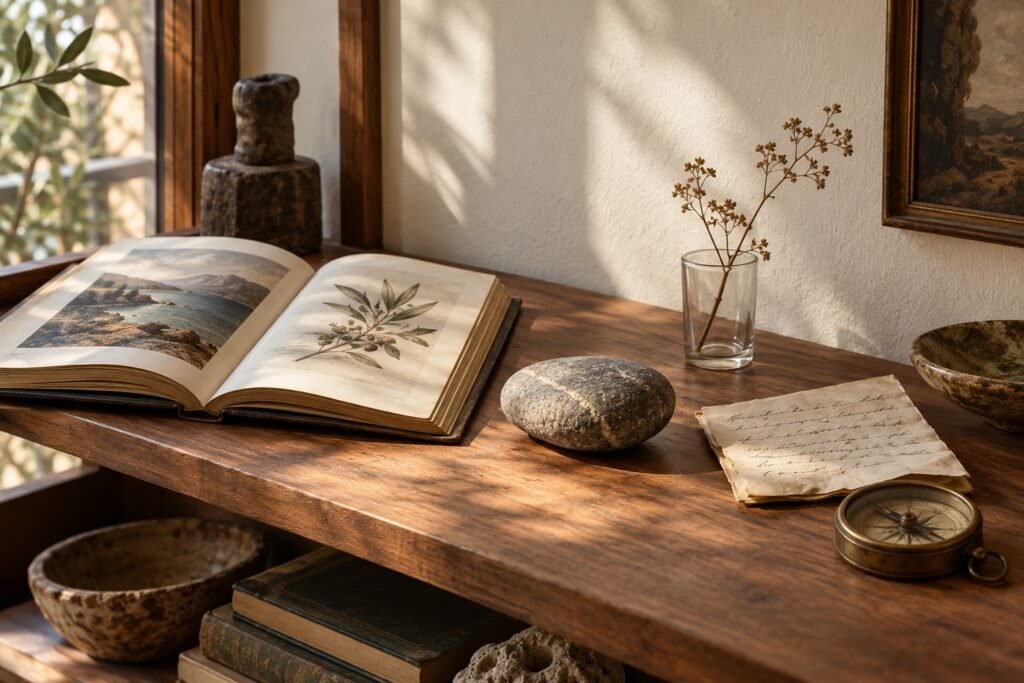
A stone picked up on a walk years ago. A ticket stub. A cup nobody drinks from. None of these are useful, which is exactly the point. They have been kept because they stand for something, and the keeper usually could not tell you what.
The order of reading
We read a shelf in a particular order. Material first, then arrangement, then the things themselves. The worn spine says this was read more than once. The book turned face out says this one matters. The empty space says there is room for more.
Symbols do their work quietly. They arrive before any explanation and they outlast it. Most of us are surrounded by them and have stopped seeing them, which is a pity, because they are the most honest record we have of who we have been.
The things we keep are the sentences we never wrote.
A small exercise for this week: pick up three objects you would never throw away. Ask what each one stands for. Then ask whether you chose them, or they chose you.
An object is never only an object
A cup bought last week and a cup kept for twenty years might be made of the same clay. One holds a drink. The other holds a drink and a relationship: a kitchen, a visitor, a particular season of a life. Its value cannot be read from its material alone.
This is one reason a tidy inventory of possessions can miss what matters. An object becomes significant through use and association. The repair in a handle may be more revealing than a maker’s mark. The thing that looks least impressive to a guest may be the first thing its owner would rescue.
Collections also tell stories through proximity. Put a postcard beside a bowl and they may recall a journey. Put the same bowl beside a family photograph and another meaning appears. Arranging a shelf is a quiet form of editing: deciding which connections to keep within sight, and which chapters can remain elsewhere.
Museums make that editing visible through labels and displays. A household usually leaves it unstated. We see the objects but not always the relationships between them. Asking someone about one small thing can open a more particular conversation than asking them to describe themselves.
There is a difference, though, between keeping a memory and feeling obliged to keep every object attached to it. We may inherit things that fit no part of the life we lead now. Gratitude does not have to mean permanent display. Sometimes a photograph, a story passed on, or a new home for an object carries the relationship forward more honestly.
Try choosing a single shelf as a small exhibition of the present. Keep one thing from the past, one thing you use and one thing you are still curious about. Leave a little space between them. The exercise is not a rule for decorating. It is a way to ask what you want to live alongside, and to hear the answer in something more concrete than an aspiration.