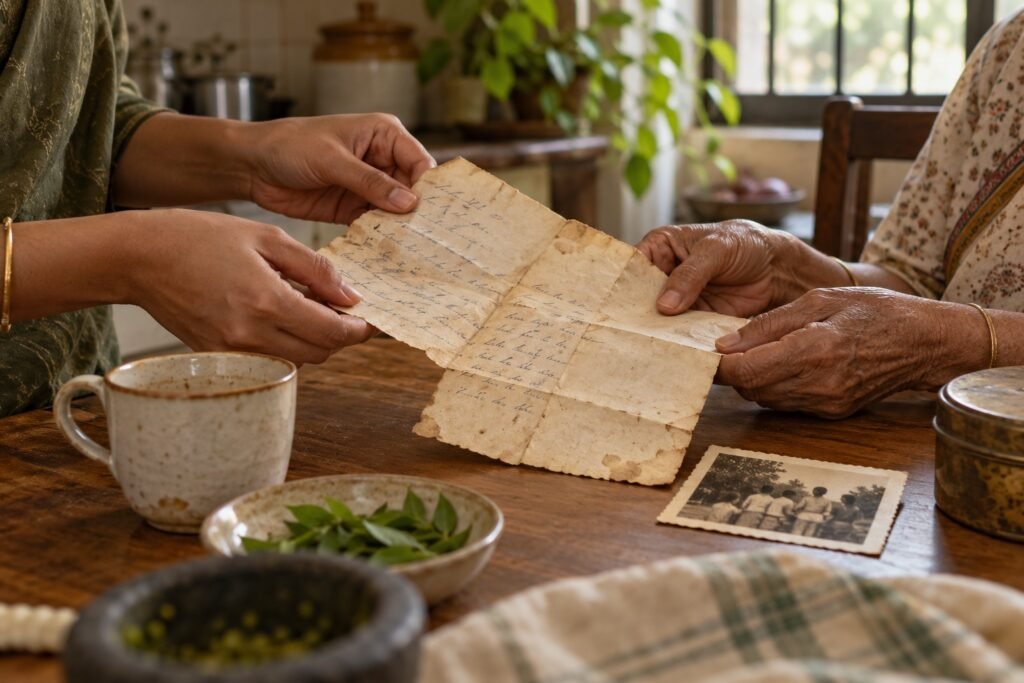
 Some of you was handed downnhum essays
Start with a habit you value, then trace who taught it to you. This essay asks how to keep an inheritance without mistaking it for the only way to live.
Some of you was handed down
We inherit more than a surname. Tempers, timings and the way we set a table come with it.
Best with: Something warm, and a chair facing a window. Keep beside you: Handmade paper notebook.
At a glance
Notice the familiar
How we disagree, welcome guests or ask for help may carry an older household’s rhythm.
Keep the question open
A learned pattern is one part of a person, not a complete explanation of them.
Choose what travels on
Keep what serves the life you want. Make room to practise another response.
What have you inherited that you would like to keep?
There is a version of every family that exists only in its habits. How loudly people disagree. Which kind of mistake is forgiven and which is not. What happens to a room when one particular person walks in tired.
None of this is written down, and all of it is passed on. We grow up arranging ourselves around these rhythms the way a plant leans toward the window.
Temperament travels
Someone raised in a house that talked everything through will look for conversation when things go wrong. Someone raised in a quieter house will go and sit alone, and may be surprised when that reads as distance. Neither is wrong. Both are invisible until someone names them.
The interesting moments come when life asks for something our inheritance did not pack. A restlessness that served us at twenty can feel like noise at forty. A carefulness that once kept us safe can start to feel like a low ceiling.
We choose our opinions. Our temperament arrives already packed.
The work is not to become someone else. It is to see the pattern clearly enough to decide which parts to keep, and which to set down gently.
Inheritance, with room for revision
At a family table, hospitality may mean filling a plate again before anyone asks. Somewhere else, it may mean leaving people free to serve themselves. When these ways meet, generosity can look like pressure and consideration can look like indifference. Both people may be trying to be kind.
The interesting question is often less “Which person is right?” than “What did each of us learn this gesture meant?” That question gives us a little distance from the habits we mistake for universal rules. It makes another interpretation possible without asking anyone to erase their history.
Inheritance is not a fixed script. We encounter teachers, friends, partners, colleagues and places that complicate our first understanding of how life works. A person who once avoided disagreement might discover a friendship in which disagreement is a form of interest. A person used to solving everything alone might slowly learn how to make a request.
These changes are usually uneven. It is easier to try a new response on an unremarkable afternoon than when we feel rushed or misunderstood. Recognising an old pattern after the fact can still be useful. A later conversation can change the meaning of what happened, even when it cannot undo it.
It also helps to resist making a single explanation do too much. Family habits are not the whole story of a person. Temperament, circumstance, culture and present relationships all matter. Curiosity becomes less useful when it turns into a verdict about where someone came from or what they must be like.
One place to begin is with a pattern you value. Who taught you to welcome someone, to repair a thing rather than discard it, to keep your word? Notice the inheritance that has helped you. Then choose one situation in which you would like a little more freedom. You need not reject the whole household to rearrange one chair at its table.