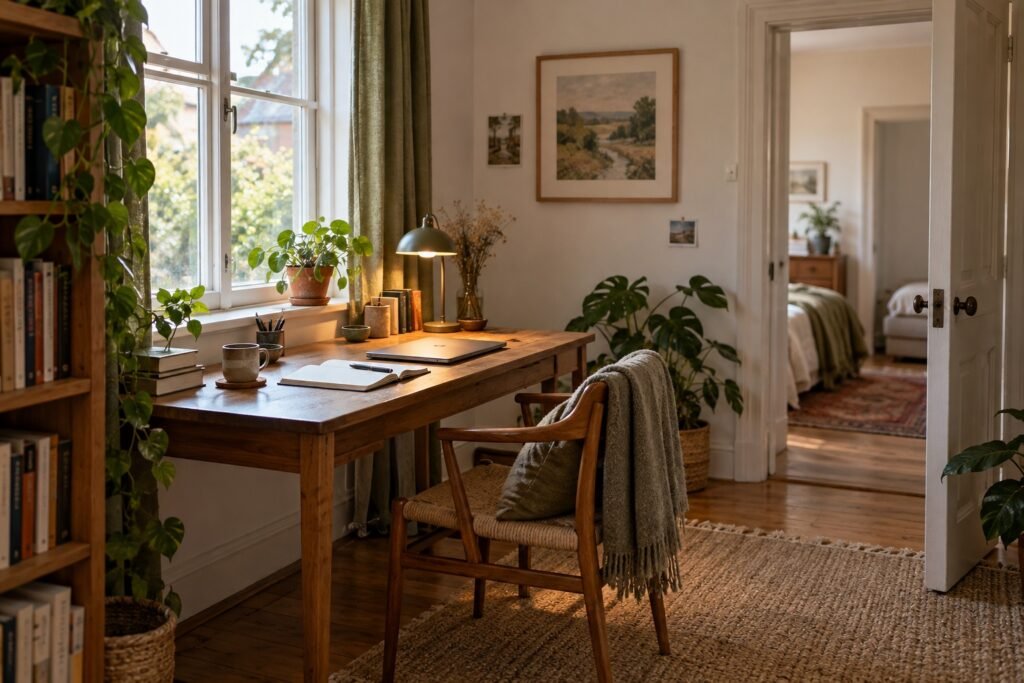
 Every room is asking you to do somethingnhum essays
Choose a chair in the room you use most. As you read, notice one thing the room makes easy and one thing it gets in the way of.
Every room is asking you to do something
Chairs, lamps and the distance between them make suggestions. We usually follow them without noticing.
Best with: A seat in the room you use most. Keep beside you: Handwoven desk cloth.
Walk into a cafe you have never been to and, within a minute, you know whether you will stay. Nobody has spoken to you. The room has.
It spoke through the height of the ceiling, the music, the one table by the window that is always taken. Later we will say the coffee was good, or that something felt off. We rarely say it was the light. But that is often where the decision began.
Space is an argument
Every room makes a suggestion. A long table invites a crowd. A single armchair under a lamp invites one person and one book. Bright overhead light suggests finishing quickly. Low, warm light suggests there is no hurry.
Good bookshops understand this better than most places. They slow you down on purpose. Tables at hand height, a chair where you might not expect one, a shelf that turns a corner. The space tells you that wandering is the point, and so you wander, and so you find something you were not looking for.
We do not just live in rooms. We take instructions from them.
The useful question at home is not whether a room looks good. It is what the room is quietly asking us to do, and whether that is what we actually want from it.
The small politics of a room
Imagine a dining table with one chair pushed against a wall. It is still a place to eat, but it has become a place where one person sits apart. Move that chair to the end of the table and the conversation may change. Space does not determine what happens; it makes some actions easier to imagine than others.
This is why a photograph cannot tell us everything about a room. It records an arrangement, while living in a room is a sequence of encounters. Where do you put the bag when you enter? Can two people pass without one stepping aside? Does the reading light illuminate a page or shine into your eyes? The experience lives in those details.
A room can also send mixed messages. A beautiful sofa may be uncomfortable to sit on. A generous table may have nowhere to put your feet. A home organised for its photograph can quietly ask its inhabitants to disturb nothing. The result is an uneasy relationship between appearing welcome and being easy to inhabit.
Public places make these invitations on a larger scale. A bench offers a reason to remain without making a purchase. A clear doorway lets someone decide whether to enter. A table that can accommodate a wheelchair makes belonging practical. Hospitality is partly an attitude, but it is also a matter of dimensions and access.
At home, a useful experiment is to follow one activity through the room. If you want to read, where is the book? Where is the lamp switch? What competes for your eye when you sit down? You may not need a new chair. You may need to move the charger, clear a small surface or put the book where your hand already goes.
None of these changes promises a different personality. Rooms are not remedies for every difficulty. They are the settings in which our days unfold, and they deserve to be judged by how they support the lives taking place in them. A considered room leaves room for people to behave like people: to pause, make a mess, speak, withdraw and return.