 The desk facing the wallnhum essays
The desk facing the wall
Before asking more of your attention, look at what your room is asking of you.
Best with: An ordinary afternoon at your own desk.
At a glance
Read the room
Light, passing movement, sound and the view from your chair all belong to the working day.
Treat theory as a question
Prospect–refuge is one way to think about outlook and shelter. It is not a universal rule for arranging a desk.
Change one thing
Try a different angle or shade the glare. Notice what helps with the task you actually do.
What is your desk asking you to keep track of, besides your work?
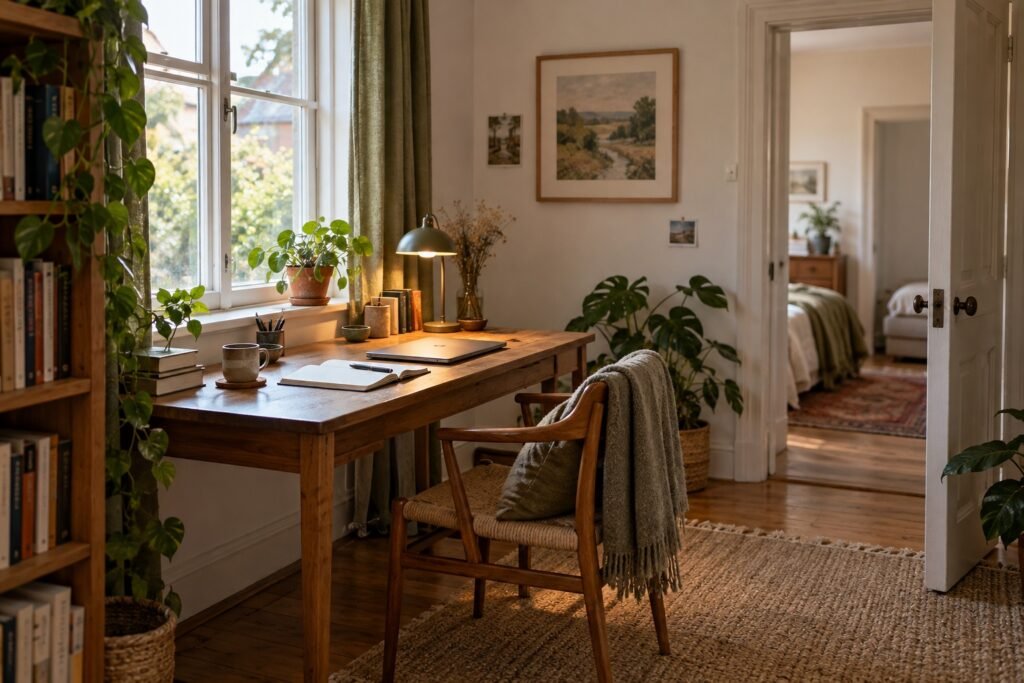
The desk fits neatly against the wall. The cables disappear behind it, the lamp sits where it should, and the rest of the room is left pleasantly open. From the doorway, the arrangement looks resolved.
From the chair, it may be a different room.
Perhaps the afternoon light falls across the screen. Perhaps someone passing behind you keeps becoming part of the sentence you are trying to write. Or perhaps the wall is exactly what you want: one quiet surface, with very little to negotiate.
The photograph cannot tell us which of these is true. Sitting down can.
A view from the chair
We tend to arrange a workspace as a collection of things: desk, chair, lamp, shelf. It is also a set of relationships. The distance to a window. The path through the room. The sound on the other side of a door. The place your eyes go when a thought needs a moment.
None of these details comes with a universal instruction. A view of the street might give one person a welcome pause and another an afternoon of interruptions. A shared table may make routine work easier and a difficult draft harder. Even the same person may need something different after lunch.
That makes a room worth observing before it is worth improving. What happens here, at what time, and for whom?
An idea, with its limits attached
Prospect–refuge theory offers one way to think about the appeal of an outlook combined with some shelter. It can be a useful question to bring to a chair or a corner. It becomes less useful when it turns into a rule that everyone must face a doorway.
A review by researchers Annemarie Dosen and Michael Ostwald found mixed evidence for the theory, with results varying by setting. A preference observed in a landscape does not automatically become an instruction for a desk. The open research is linked below, including its uncertainties.
There are more immediate questions available without asking a theory to decide the room for you. Can you read the screen without leaning away from the light? Does the chair leave enough room to move? Are you listening for traffic behind you? Is the surface full of objects that belong to unfinished tasks?
These are descriptions of an experience you can inspect. They need not become a diagnosis of your attention.
Try a smaller rearrangement
Before buying another object for the desk, change one relationship. Angle the screen. Move the lamp. Try the other side of the table for a piece of work that needs concentration. If moving furniture is impractical, a blind, a quieter hour or a cleared corner might be the available adjustment.
Give the change an ordinary working day. Notice what becomes easier and what becomes awkward. A room that looks less composed from the doorway may work better from inside it. Or the original position may turn out to be right, once the glare is dealt with.
The point is to make room for your own evidence. Practical constraints belong in the experiment too: a shared home, a small room, a socket that refuses to be anywhere else. A useful space has to accommodate the life already happening around it.
Michael Pollan’s A Place of My Own follows the much larger undertaking of building a room in which to read and write. Most of us will begin with a more modest territory. A chair. A patch of daylight. A surface on which a thought can stay open for a while.
Look at your desk from the place where you actually sit. What does it help you do? What does it keep asking you to notice? The answer may be smaller, and more useful, than a new workspace.